

November 4, 2025
The people of Tokelau are celebrating the launch of the first-ever complete Bible translation in Tokelauan, their heart language. Held on Fakaofo Atoll on October 27, the launch event marked the culmination of 26 years of faithful work, collaboration, and prayer, and coincided with Tokelau Language Week in Aotearoa (New Zealand).
Bible Society New Zealand (BSNZ) CEO Neels Janse van Rensburg reflected:
“This achievement is a testament to the power of partnership and the perseverance of God’s people. It shows what can happen when translation, community, and faith come together.”
 26 Years of Faithfulness
With the support of BSNZ and UBS, the local community’s vision for a complete Tokelau Bible, a dream that had been for decades prior, finally became a structured project in 1996. It was formally launched through a translators’ workshop hosted by BSNZ. Over the following decades, teams of translators, linguists, and advisors worked diligently to bring scripture to life in Tokelau’s own words. The task was monumental—not least because Tokelauan had long been an oral language, with early translators first needing to develop consistent written forms and grammar before translation could begin.
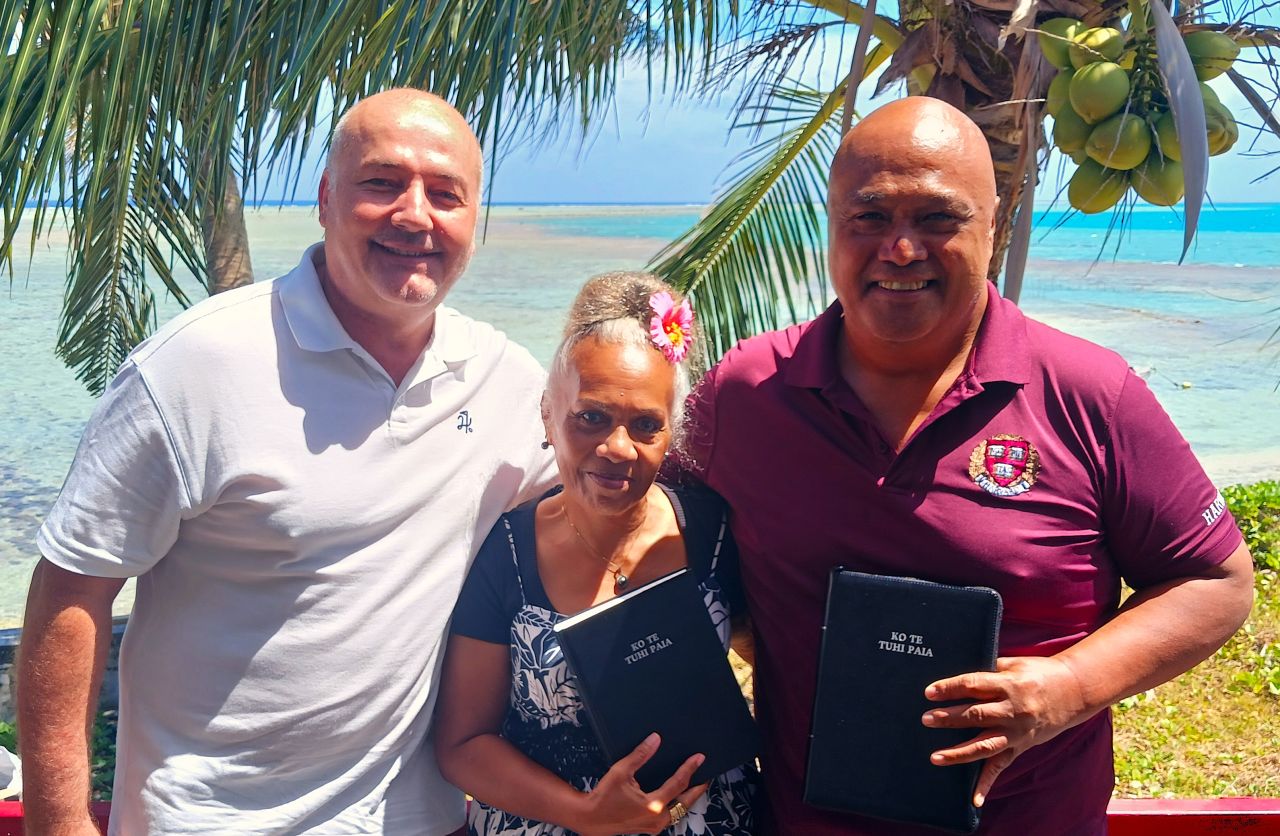
Central to this effort was Ioane Teao, (pictured, left, with Dr. Stephen Pattemore) who dedicated over 23 years to the work, and Rev. Tui Sopoaga, who chaired the translation committee. Together with Dr. Stephen Pattemore, BSNZ’s now-retired Translation Director, they performed the final verse check in 2019. Dr. Clare Knowles, Abi Das, and Daniel Harrison guided the final stages of typesetting, design, and publication, ensuring the Bible would be ready in time for the long-awaited celebration.
Janse van Rensburg also recognised UBS support for the project: “UBS provided earlier translation advisory and consultancy services in the pioneering years of the project, technical tools, such as Paratext, and strategic guidance that were essential to this project’s success.”
 Bible Preserving Language
The idea of a Tokelauan Bible originated in the late 1960s, as Tokelauans began migrating to New Zealand. While the Samoan Bible served earlier generations, the Tokelauan community born in New Zealand faced a new reality; many were no longer fluent in Samoan. The need for Scripture in their native language became urgent.
In the 1980s, Tokelauan was becoming the preferred language of worship. However, without a Bible, this shift could not reach its full potential. In 1991, initial meetings were held by PIPC Grey Lynn and Porirua, followed by consultations across Auckland, Hutt Valley, Rotorua, and Taupo. These efforts culminated in a delegation visiting Tokelau in 1994 to seek approval for this work. Supported by the government, Taupulega, and church groups, the project officially began in June 1996 under the Tokelauan Society for the Translation of the Bible, in partnership with BSNZ and UBS.
The Bible’s arrival represents a linguistic and cultural rejuvenation. For generations, Tokelauans have relied on the Samoan Bible for Old Testament readings and the portions available to them in Tokelauan. In 1999, the Gospel of Mark was published, and four years later, the Four Gospels were released. In 2009, the New Testament was launched with a celebration at Pahina Church. For the first time now in 2025, God’s Word in full can be read, heard, and cherished in Tokelauan.
An Event of Cultural Significance
In the two days after the launch event, the BSNZ team who travelled to Tokelau for the launch, were honoured as part of the Tokelaun parliamentary sitting. The parliament thanked all involved for the work on the Bible, which culminated in a cultural evening of song and dance presented by the people from the three tropical coral atolls named Atafu, Nukunonu, and Fakaofo.
The BSNZ team was also presented with a gift called a “Toluma” – a wooden container that was held in canoes when out at sea. These containers held the valuables, the catch, and everything the sailors needed, and, should the boat capsize, this vessel will float and eventually take its contents to wherever it lands. This was presented to the Bible Society, an organisation that brings the Bible, hope, and wisdom to communities.
Tokelau community leader and former Ulu-o-Tokelau (the Tokelaun head of government), Kelihiano Kalolo, described this new Bible translation as “a very big event” and a powerful reminder to preserve and strengthen the language. “It will be good for the development of the spiritual life of people that will lead to harmonious living in the villages,” he said. Others spoke of the Bible as a “canoe” – keeping their language and culture afloat in an ever-changing world. This new Bible stands as a reminder that each translation is a bridge between God and His people, renewing both faith and culture for generations to come.
 Life and Faith in Tokelau
Tokelau is a small territory of New Zealand in the southern Pacific Ocean, comprised of three atolls named Atafu, Nukunonu, and Fakaofo, approximately 10-12 square kilometres in size.
Approximately 480 kilometres north of Samoa, halfway between Hawaii and New Zealand, it is typically accessible by boat from Samoa, a one-way journey that takes approximately 24 hours.
Tokelau’s population is approximately 1,500 people, making it the fourth-smallest population of any sovereign state or dependency in the world.
The majority of people in Tokelau are Christians, and Christianity plays a significant role in the Tokelauan way of life. Finally, they have a Bible in their heart language to further enrich their faith into the future.